Astronomers from the University of Central Lancashire have identified a colossal arc of galaxies spanning over 3.3 billion light-years. If confirmed, this would rank among the largest known structures in the cosmos.
The cosmological principle of homogeneity and isotropy posits that the Universe looks the same from any vantage point, with no preferred direction or location. Yet, structures larger than about 1.2 billion light-years challenge this model, suggesting they shouldn't exist on such scales. Observations, however, prove otherwise.
Over recent years, astronomers have cataloged several enormous formations. The Sloan Great Wall, for instance, measures more than 1.5 billion light-years across. The South Pole Wall extends over 1.37 billion light-years.
The record-holder remains the Hercules-Corona Borealis Great Wall, a galactic filament in the constellations Hercules and Corona Borealis that stretches across more than ten billion light-years—the largest and most massive structure in the observable Universe to date.
In their latest study, the UK team detected another behemoth: a bow-shaped cluster of galaxies located 9.2 billion light-years away, with a diameter exceeding 3.3 billion light-years. This finding is generating significant buzz.
“The growing tally of large-scale structures surpassing theoretical size limits is impossible to overlook,” states lead author Alexia Lopez, who presented the research at the 238th meeting of the American Astronomical Society.
The team analyzed data from the Sloan Digital Sky Survey, examining light from more than 40,000 quasars—extremely luminous galaxies powered by supermassive black holes at their cores.
As this light travels through intergalactic gas, specific wavelengths are absorbed, creating spectral lines that reveal matter distribution. Here, absorption by ionized magnesium atoms outlined a near-symmetrical arc of dozens of galaxies, spanning roughly one-fifteenth of the observable Universe's radius.
Invisible to the naked eye, this arc would appear about 20 times wider than the full Moon, according to Sciencenews.
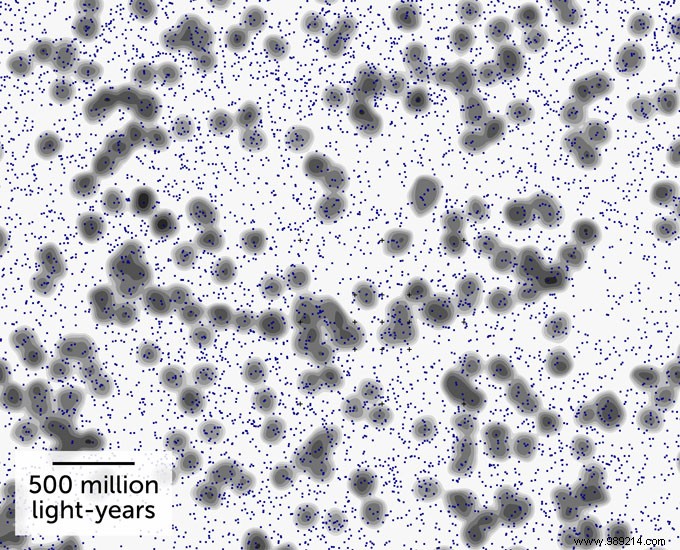
The detection boasts a confidence level of 99.9997%, or 4.5 sigma—impressively high, though the gold standard of 5 sigma awaits final validation. Follow-up observations are underway.
