Years ago, NASA selected Jezero Crater as the ideal landing site for the Perseverance rover, designed to search for signs of ancient life on Mars. Satellite images hinted at a former lake there. Now, direct evidence from the rover solidifies this, as detailed in a new Science journal study.
Today, Mars is a cold, dry world. Yet, orbital data revealing valley networks and sedimentary features point to a warmer, wetter past. Questions linger about the duration, timing, and nature of that water activity—key to assessing Mars' habitability.
The Mars 2020 mission, led by Perseverance, kicks off the effort to return samples to Earth for biosignature analysis.
Jezero Crater (45 km wide) was chosen based on orbital images showing sedimentary fans on its western and northern rims—likely river deltas from an ancient lake basin dating to 3.6–3.8 billion years ago. Orbiting spectrometers also detected phyllosilicates and carbonates, hallmarks of past water.
Previously, evidence was indirect. Now, Perseverance's on-site analysis provides ground truth. Using Mastcam-Z and Remote Micro-Imager (RMI), it imaged steep cliffs 2.2 km northwest and the 'Kodiak' knoll southwest, exposing layered rocks and sediments.
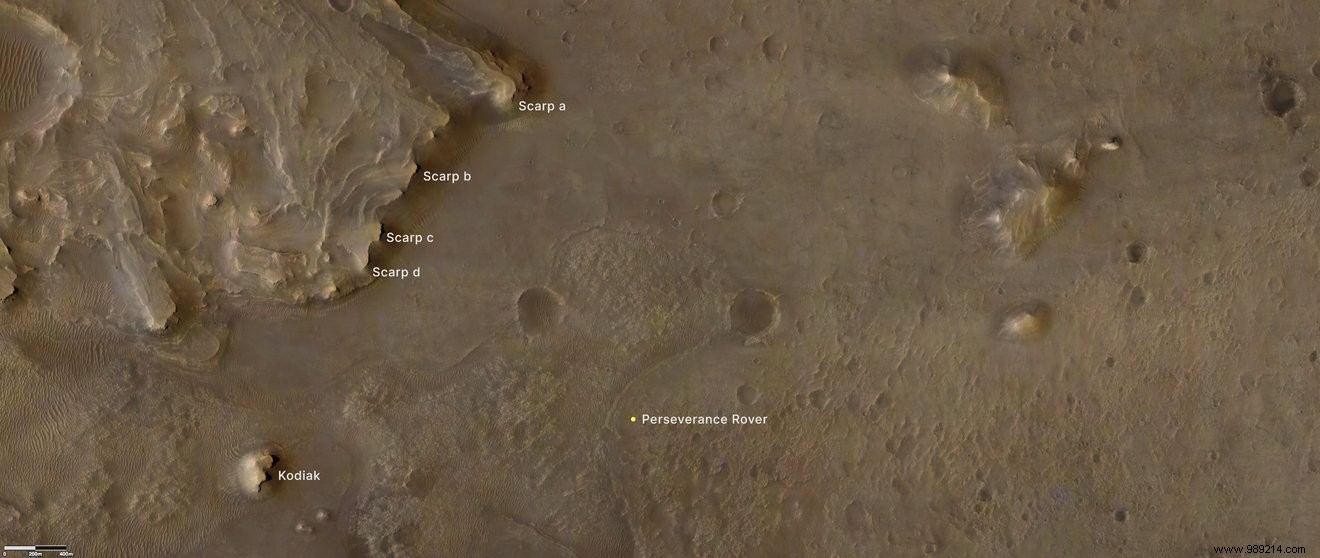
The data confirms Jezero once held an ancient lake, calm for much of its ~3.7-billion-year history until climate shifts unleashed episodic megafloods.
In the delta's upper layers, massive boulders and pebbles appear—some up to a meter wide and weighing tons. Sourced from the crater rim tens of kilometers away, these were transported by powerful flash floods into the lake bed.
With lacustrine origins verified, Jezero's sediments are prime targets for preserving ancient microbial life traces.
