Unlike NASA's swift releases from its Mars 2020 mission, why has China delayed publishing the initial findings from its Tianwen-1 Zhurong rover?
Launched as part of China's Tianwen-1 mission, the Zhurong rover touched down on Mars on May 14, 2021, and deployed successfully within a week. This achievement made China the second nation to land on Mars and communicate from its surface. The China National Space Administration (CNSA) completed the primary mission objectives and entered an extended operations phase. Yet, since landing, CNSA has shared limited updates on Zhurong—unlike NASA's frequent Perseverance rover announcements.
Nature journalist Smriti Mallapragada detailed this in a November 30, 2021, article, highlighting the reasons behind the holdup. Like other Mars missions, Zhurong entered a hibernation during solar conjunction in September, disrupting communications. It resumed operations in October, traveling an additional 200 meters. This pause enabled CNSA to start processing initial data.
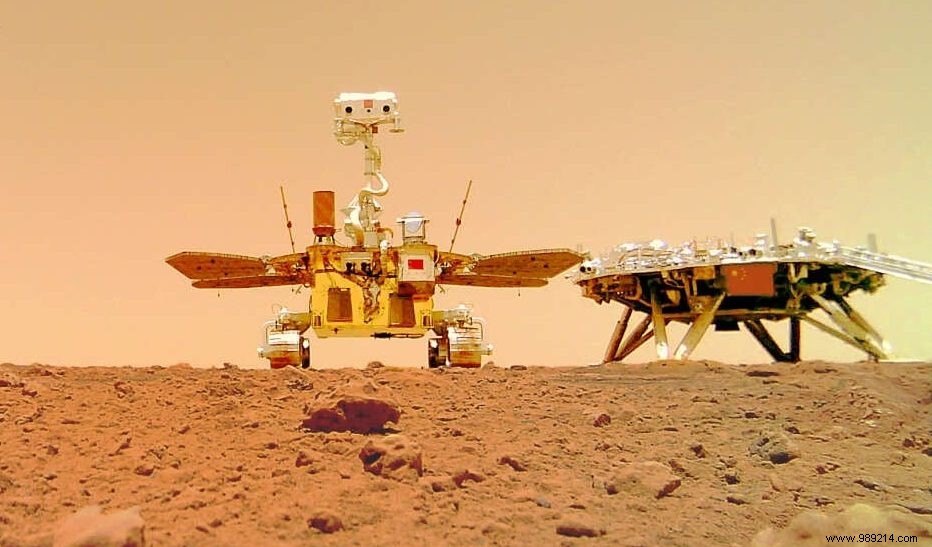
Several factors contribute to the delay. First, the data volume is massive: 200 GB collected from February to June 2021 requires thorough cleaning and validation to ensure accuracy and remove instrument noise. This includes navigation camera images, weather data (wind speed, temperature, pressure), soil/rock chemical compositions, sand dune analyses, and potential subsurface insights.
CNSA's relative inexperience compared to NASA also plays a role, as do differing workflows. The National Astronomical Observatories of China (NAOC) reviews all orbiter and rover data before limited scientist access. In contrast, Perseverance's instruments are team-developed, granting exclusive data access for months prior to public release.
That said, CNSA has shared some updates: an August 2021 paper on landing site geology and a September publication on surface properties.
